
The Facebook Breast Cancer Meme: Flippy Failure or Misinformed Messaging?
- Dawn M. Keddy

- Nov 10, 2024
- 4 min read
If you’re one of hundreds of thousands of Facebook users who participated in the tech giant’s breast cancer awareness campaigns, then you’re probably familiar with their meme strategy.
The campaign asks women to engage with the meme by performing a specific action and encouraging their friends to do the same. That’s it. Nothing more.
Sounds great, right?
It’s a fun way for Facebook users to raise awareness and become part of an important messaging campaign. But to what end? What do the Facebook memes actually do to help the breast cancer awareness cause or support the fight to find a cure?
Not so much, according to ABC News Author, Susan Donaldson James, “Instead, these online antics may be raising more attention for women's anatomy than for breast cancer research” (James, 2010). And, on that note, while there’s an increase in the number of breast exams in October, statisticians cannot confirm whether the increase is due to the October awareness campaign or the Facebook meme campaign.
The memes simply entertain users and encourage others to play along, but funding is absent, so it does nothing to further research or provide relief to survivors.
Viral Qualities
So, the meme generates a lot of buzz and community interaction because it’s fun, right? I mean, who doesn’t like being part of the crowd (besides me, that is), joining the party, doing what your friends are doing?
To appeal to the masses, Facebook used a mobilization technique called Cyberactivism, where “individuals utilize the Internet to promote a particular cause or charity” (Mahoney & Tang, 2016, p. 71). While Cyberactivism spreads information quickly, it does not encourage mobilizational behavior change to support the actual cause for which the rallying cry was made.
But why participate and share with friends? Typically deployed at the beginning of October, Breast Cancer Awareness Month, the meme campaign hijacks the cause with a socially interactive meme.
The reason it has gained so much popularity is because of its sexual connotations. The Facebook status updates were cryptically sexualized and exploitative.
And the guys loved it!
Poor Mobilization Strategy
While the meme’s callout mobilized hundreds of thousands of users to play along and users grew the community by inviting their friends to play, it only raised awareness and verbal support. It failed to raise financial support for breast cancer research or to aid those afflicted with the disease. It even failed to move users to volunteer, engage in Relay for Life, or perform other tangible actions.
Simply put, the meme campaign did not reach far enough to include a financial support element.
In other words, it failed to produce a beneficial response to the cause. It’s one thing to have a mass of people verbally support a cause but a much bigger thing when the awareness causes action-oriented movement, funding support, and “boots on the ground” community engagement.
Sexy Facebook Double Standard
Facebook encouraged the sexualized meme campaign when it posted a comment suggesting horny non-supporters were a welcomed group.
“Whether you are a full-fledged Breast Cancer supporter or a shameless, sexually-charged horndog, this page is for you” (Albanesius, 2010, as cited by Mahoney & Tang, 2016, p. 72) read one post on the meme’s Facebook fan page.
But when one survivor posted a picture of their breastless, tattooed torso, Facebook removed the post, citing a nudity violation. It was clearly a work of art, an inspiration to survivors, and Facebook’s move was a double standard.
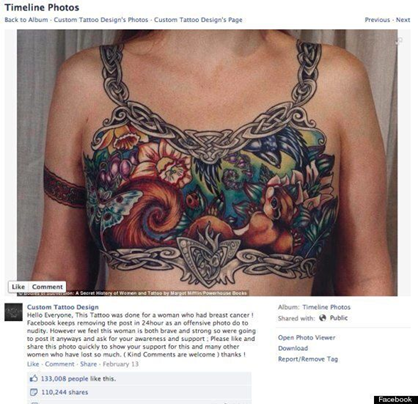
Source: Custom Tattoo via Huffington Post - Facebook 'Removes Image Of
Breast Cancer Survivor's Double Mastectomy Tattoo Over Nudity Violation'
Ironically, as their policy is written, Facebook users are advised not to post “uncovered female nipples except in the context of…health-related situations…post-mastectomy, breast cancer awareness” (Facebook).
Embrace Change to Make a Difference
Rather than simply prompting people to share the color of their bras or where they like to put their purses, the meme could better utilize Facebook’s billion-user platform by adding an action-oriented component, like a financial element prompting users to donate, and rewarding users with a digital badge to indicate they contributed – along the same lines as the little paper rose you get when you donate to your local Legion at the road toll outside the market.
But Wait - What about Man-boobs?
Let’s not forget that this is not just a women’s issue. In fact, men make up one in one thousand breast cancer diagnoses every year and, sadly, some die. In fact, according to The American Cancer Society (2021), “about 2,650 new cases of invasive breast cancer will be diagnosed” in 2021, “and about 530 men will die” from the disease.

The Facebook status updates were geared toward women, their bras, and their purses, which is aimed squarely at the female population of breast cancer survivors.
By doing so, the campaign discriminated against men with breast cancer and the meme’s sexual connotations garnered more attention from the female user’s male friends than the intended support for the cause associated with it.
The Bottom Line
To promote real change and raise more than just eyebrows, Facebook needs to step up its breast cancer awareness meme campaign by using impactful action-oriented mobilization strategies and less Cyberactivism game-play.
References
American Cancer Society. (2021, January 12). Key Statistics for Breast Cancer in Men. American Cancer Society. https://www.cancer.org/cancer/breast-cancer-in-men/about/key-statistics.html#written_by.
Casserly, M. (2012, March 26). 'I like it on the...' kinky Facebook meme for breast cancer.
Facebook. Community standards. (n.d.).
James, S. D. (2010, January 8). Bra color status on Facebook goes viral. ABC news. https://abcnews.go.com/Health/bra-color-status-facebook-raises-curiosity-money-viral/story?id=9513986.
Mahoney, L. Meghan; Tang, T. (2016). Strategic social media: From marketing to social change. (pp. 71, 72, 73). Wiley-Blackwell. https://www.amazon.com/dp/1119890365.
Nelson, S. C. (2013, February 22). Facebook 'removes image of breast cancer survivor's double mastectomy tattoo over nudity violation' (picture). HuffPost UK. https://www.huffingtonpost.co.uk/2013/02/19/facebook-removes-breast-cancer-survivors-double-mastectomy-tattoo-picture_n_2716057.html.

Comments